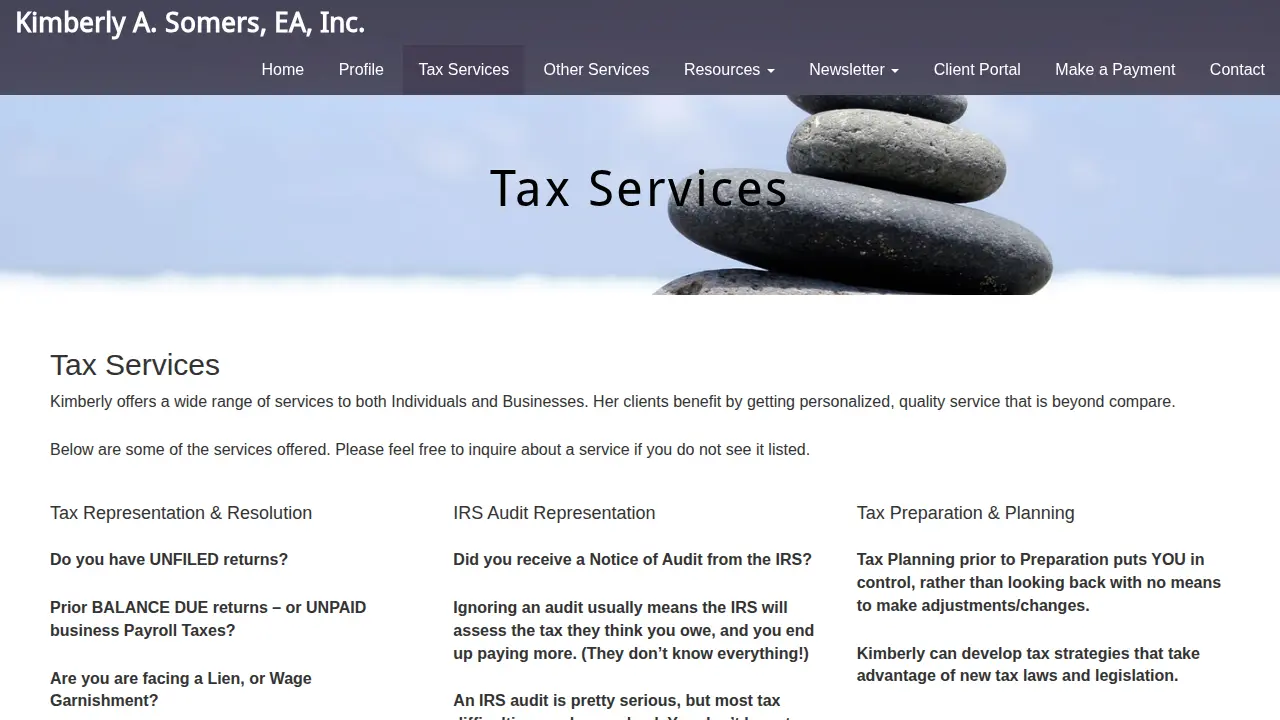
Kimberly A. Somers, EA, Inc. offers a full suite of tax services including tax preparation, bookkeeping, payroll processing, tax audits, representation, projections, financial statements, cash management, budgeting, and personalized financial guidance.
With over 39 years of experience and a commitment to excellence, the firm helps clients navigate IRS audits, resolve unpaid taxes, and optimize financial strategies.
Nationwide IRS representation
Personalized financial guidance
High standards, work ethic, and integrity
Experienced and knowledgeable team
Services
Tax Preparation & Bookkeeping
Comprehensive tax preparation and bookkeeping services for individuals and businesses.
Accurate financial informationGood financial recordsGeneral ledger preparationPayroll processing
Tax Audit Representation & Resolution
Representation and resolution services for IRS audits, liens, levies, and wage garnishments.
Unfiled returns assistanceBalance due returns resolutionLien and wage garnishment handling
Tax Planning & Projections
Strategic tax planning and projections to optimize tax outcomes.
Strategic tax planningNew tax law analysisTax strategy development
Financial Statements & Cash Management
Preparation of financial statements and cash management solutions.
Assistance in selecting the optimal business entity structure.
Entity type evaluationTax implications analysisLegal considerations
Payroll Processing & Reporting
Accurate payroll processing and reporting services.
Payroll setupPayroll processingReporting
Credentials & Certifications
Enrolled Agent (EA)
Since 1986
Reviews
Rating
4.6
★★★★★
Reviews
9
Frequently Asked Questions
What is the difference between a sole proprietorship, S corporation, and LLC? +
A sole proprietorship is a single-owner business with no legal distinction from the owner, offering simplicity but full liability. An S corporation provides limited liability protection and allows pass-through taxation, with specific eligibility requirements. An LLC (Limited Liability Company) combines liability protection with flexible tax options, allowing members to choose how the business is taxed.
How long should I keep my tax records? +
The IRS generally requires that you keep tax records for three years from the date of filing the return or two years from the date you paid the tax, whichever is later. However, for certain situations like claiming a loss on the sale of property, you may need to keep records for up to seven years.
What is the American Opportunity Tax Credit (AOTC)? +
The American Opportunity Tax Credit is a federal tax credit available to taxpayers for qualified education expenses of a designated student. It covers up to 100% of the first $2,500 in tuition, fees, and course materials per academic year for the first four years of post-secondary education.
Can I deduct the interest I paid on my student loans? +
Yes, you may be able to deduct up to $2,500 of the qualified student loan interest you paid during the year, regardless of whether you itemize deductions. The deduction is subject to income limits.
What should I do if I receive an IRS audit notice? +
If you receive an IRS audit notice, do not ignore it. Contact a qualified tax professional like Kimberly A. Somers, EA, to represent you and help resolve the audit. Provide all requested documentation promptly and cooperate fully with the IRS.
How does the Home Office Deduction work? +
The Home Office Deduction allows eligible taxpayers to deduct a portion of home-related expenses if they use a part of their home exclusively and regularly for business. Required records include proof of the size of the home office area and deductible expenses like rent, utilities, and maintenance.
 4.6